
Builder's risk insurance is a specialized form of property insurance designed to protect construction projects. It serves as a temporary financial shield, covering the structure, materials, and equipment on-site from the moment work begins until the project is completed and handed over. This policy stands between an unexpected event—such as fire, theft, or vandalism—and a catastrophic financial loss for all parties involved.
The Foundation of a Secure Construction Project
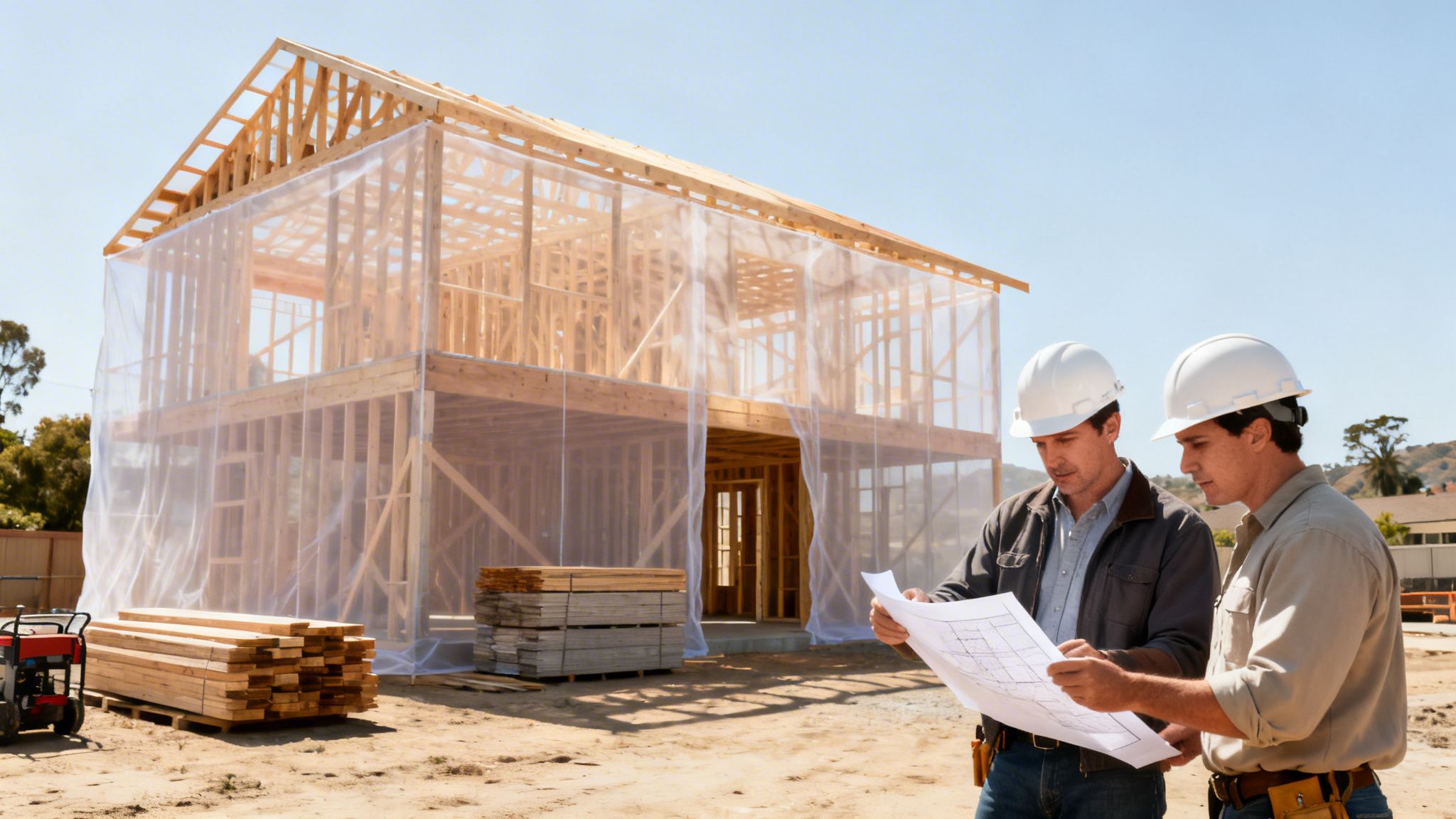
Consider the practical realities of a construction site. Whether it is a new custom home or a commercial retail space, thousands of dollars are invested daily in the form of lumber, concrete, wiring, fixtures, and skilled labor. This growing investment remains completely exposed to various risks. What happens if a sudden windstorm collapses the framing? Or if thieves steal a significant shipment of copper piping overnight?
Without adequate protection, the financial responsibility for these losses falls directly on the project stakeholders, potentially halting progress indefinitely. Builder's risk insurance is specifically designed to prevent this exact scenario by providing the capital to recover from such setbacks.
Builder's Risk Insurance At a Glance
| Key Aspect | Description |
|---|---|
| What It Is | A temporary property insurance policy that covers a structure while it's under construction. |
| Primary Protection | Covers the building, on-site materials, and sometimes equipment against events like fire, theft, wind, and vandalism. |
| Who It Protects | The property owner, general contractor, subcontractors, and lenders—anyone with a financial stake. |
| When It's Active | From the start of construction until the project is completed or handed over. |
The true value of this policy lies in its capacity to protect every party involved in the project.
Who Exactly Needs This Coverage?
A common misconception is that this policy is solely for the general contractor. In truth, it safeguards everyone who has a financial stake in the project—what is known in the insurance industry as an "insurable interest."
A well-structured policy should cover all key players:
- The Property Owner: The individual or company financing the project has the most to lose and is a primary insured party.
- The General Contractor: The entity responsible for overseeing the project through to completion.
- Subcontractors: Plumbers, electricians, roofers, and other specialists whose work and materials are integral to the final structure.
- Lenders: Banks and financial institutions almost always require this coverage to protect the loan they’ve issued for the project.
A builder's risk policy is the financial glue that holds a project together when unforeseen events occur. It provides the funds to repair damage and maintain momentum, preventing disputes over financial responsibility.
This comprehensive protection is why it has become an industry standard. It's estimated that by 2026, builder's risk insurance will cover a staggering 89% of all U.S. construction projects, a figure that underscores its indispensability on modern job sites.
Why It's Non-Negotiable in California
In California, the stakes are elevated due to unique environmental threats like wildfires and earthquakes. Robust insurance coverage is not merely a prudent business decision; it is an operational necessity. A standard builder's risk policy provides a strong foundation that can be customized with endorsements for region-specific risks.
Understanding the components of a complete construction insurance plan is the first step toward a secure and successful build, no matter what challenges arise.
Understanding What Your Policy Actually Covers
A builder’s risk policy is more than a compliance tool; it is the financial hard hat for the entire project. To appreciate its value, one must look beyond insurance terminology to understand the physical assets it protects from the moment of groundbreaking.
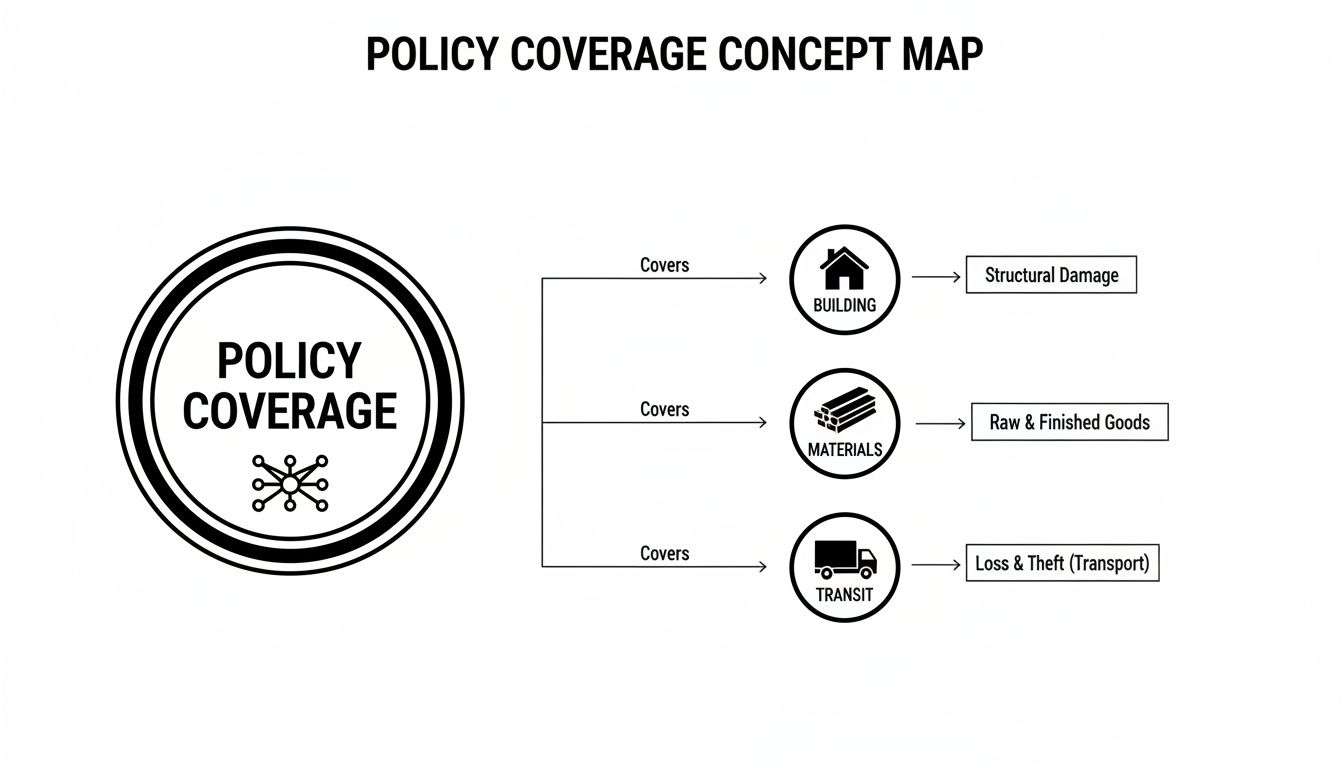
At its core, the policy covers the building or structure itself. This includes everything that becomes a permanent part of the final project—from the foundation and framing to the roofing, drywall, and installed fixtures. If a sudden storm damages the framing or a fire breaks out, this coverage pays to rebuild and restore progress.
Protecting Your Materials and Supplies
A building is constructed from thousands of components, and a comprehensive builder's risk insurance policy protects these materials and supplies as well. This is critical, as an active job site functions as a high-value, open-air warehouse.
Your coverage should protect assets such as:
- Materials Stored On-Site: This includes stacks of lumber, pallets of shingles, boxes of wiring, and plumbing pipes awaiting installation.
- Fixtures and Equipment: High-value items like HVAC units, custom windows, doors, and lighting are also covered while on the property.
- Materials in Transit: Many policies extend coverage to materials while they are being transported to the site, protecting the investment before it even arrives.
Consider this: a crew arrives on Monday morning to find that a trailer of expensive copper piping has vanished. Or, a forklift operator accidentally shatters a pallet of custom-ordered windows. These are real-world scenarios where the policy becomes a lifeline, covering replacement costs to prevent a minor setback from becoming a budget disaster.
The Two Flavors of Coverage: Named-Peril vs. All-Risk
When evaluating policies, you will encounter two primary types: "named-peril" and "all-risk." The choice between them is one of the most important decisions, as it fundamentally dictates how the insurance responds to a claim.
A named-peril policy is highly specific. It only covers losses from the exact risks—or "perils"—listed in the policy, such as fire, wind, or vandalism. If a loss is caused by something not on that list, there is no coverage.
An all-risk policy (also known as a "special form" policy) functions in the opposite manner. It covers damage from any cause, unless that cause is specifically listed as an exclusion. This provides a much broader and more robust form of protection suitable for the unpredictable nature of a construction project.
For any construction project, an all-risk policy is almost always the superior choice. It shifts the burden of proof, ensuring coverage for a vast range of unexpected events without requiring the policyholder to demonstrate the cause was on a pre-approved list.
The dynamic environment of a job site is filled with variables. An all-risk policy is engineered for that uncertainty, offering genuine peace of mind that the investment is secure.
You can also proactively minimize risks. Implementing strong strategies for construction site security is an effective way to reduce the likelihood of theft and vandalism, which complements your insurance coverage perfectly.
Understanding Exclusions and Essential Add-Ons
A builder's risk policy serves as a blueprint for financial protection. It clearly defines what is supported but, just as importantly, highlights potential gaps. No policy provides universal coverage out of the box. Understanding these inherent limitations—known as exclusions—is the first step toward ensuring a project is genuinely secure.
A standard policy is designed to cover unexpected physical damage, not to rectify professional errors or predictable events. Consequently, exclusions for issues like faulty design, poor workmanship, or employee theft are nearly universal. While these are serious risks, they are intended to be covered by other types of policies, such as professional liability or crime insurance, rather than property coverage.
Common Gaps in a Standard Policy
Without a thorough review, a standard policy can leave a project dangerously exposed. Here are the key exclusions to watch for:
- Earth Movement: This is a significant exclusion, covering everything from earthquakes and landslides to sinkholes. In a location like California, leaving this gap unaddressed is a high-stakes gamble.
- Water Damage: This exclusion does not typically apply to a plumber's leaky pipe but rather to widespread events like floods, storm surges, and sewer backups.
- Faulty Design or Workmanship: The policy is designed to pay for damage to the project, not to correct mistakes in the project. If a poorly engineered wall collapses, the policy will not cover the cost to redesign and rebuild it correctly.
- Mechanical Breakdown: If equipment on-site, such as a generator, fails due to an internal malfunction, it is generally not covered by builder's risk.
Identifying these exclusions is not about finding weaknesses; it is about finding opportunities to reinforce coverage where it matters most for a specific project.
Closing the Gaps with Endorsements
This is where coverage customization occurs. An endorsement (or rider) is an add-on that modifies a policy to cover a specific risk that was originally excluded. It is analogous to adding a high-tech security system to a new building after recognizing that a standard door lock is insufficient for the neighborhood.
For instance, the global builders risk insurance market is projected to grow at a 7.5% CAGR, largely because the modern construction boom demands more specialized coverage. This growth encourages insurers to offer better and more flexible endorsements, which benefits policyholders.
To help identify and address coverage gaps, here is a quick comparison table.
Standard Exclusions vs. Recommended Endorsements
| Common Exclusion | Recommended Endorsement or Solution |
|---|---|
| Flood, Storm Surge, Sewer Backup | Flood Insurance or a specific flood endorsement. |
| Earthquake, Landslide, Earth Movement | Earthquake Endorsement, which is critical in California. |
| Faulty Design & Workmanship (Resulting Damage) | A "Resulting Damage" clause can sometimes cover the collateral damage caused by the initial faulty work. |
| Soft Costs (Interest, Permit Fees) after a delay | Soft Costs Endorsement to cover these non-physical financial losses. |
| Building Code Upgrades after a loss | Ordinance or Law Coverage to pay for demolition and increased rebuilding costs. |
| Theft of Uninstalled Materials | A Theft Endorsement can broaden coverage for stolen copper, lumber, and other valuable materials. |
This table serves as a starting point. The optimal combination of endorsements will always depend on the project's location, scope, and specific vulnerabilities.
Must-Have Endorsements for California Projects
In California, our unique risks mean certain endorsements are less of a "nice-to-have" and more of a necessity. Two of the most critical add-ons for any local project are:
- Ordinance or Law Coverage: Imagine a fire damages 50% of a nearly finished building. A new city ordinance now requires demolition of the undamaged half and rebuilding the entire structure to a stricter, more expensive code. A standard policy will not cover these extra costs. This endorsement covers the demolition of the undamaged portion and the increased cost of construction to meet new legal requirements. It can be a financial lifesaver.
- Soft Costs Coverage: When a fire or major storm halts a project, the cost of repairs is only one part of the financial burden. Loan interest, architect fees, legal expenses, and permit costs continue to accumulate during the delay. This endorsement reimburses for these indirect financial losses, often called "soft costs," preventing the project from becoming insolvent during rebuilding.
Given the seismic reality of our state, a deeper exploration of earthquake protection is non-negotiable. We strongly recommend reading our guide on earthquake insurance in California to fully understand how to shield your investment from this ever-present threat.
Who Needs a Policy and When to Purchase It
It is a common misunderstanding that builder's risk insurance is solely the responsibility of the general contractor. In reality, this policy is designed to protect everyone with a significant financial stake in the project. If you stand to lose money if the job site is damaged, you have an "insurable interest" and need to be covered.
A robust policy does not just list one party; it names several key players as insureds to ensure comprehensive protection.
- The Property Owner: As the entity funding the project, the owner has the most to lose and is a primary beneficiary.
- The General Contractor: The GC manages the build and relies on this coverage to safeguard the work in progress and on-site materials.
- Subcontractors: Plumbers, electricians, and framers all have their labor and materials invested in the project and require protection.
- Lenders: Any bank or financial institution providing a loan will almost certainly mandate this coverage to protect their capital.
Who Should Buy the Policy
So, who should purchase the policy—the owner or the contractor? While allowing the contractor to handle it might seem convenient, the property owner gains far more control and peace of mind by purchasing the policy directly.
When the owner buys the policy, they control the terms. They set coverage limits, add crucial endorsements for risks like soft costs, and receive direct confirmation that the policy is active and paid. If the contractor buys it and merely lists the owner as a loss payee, the contractor remains in control—they receive all notifications, including cancellations, and claim checks are sent to them.
Having the owner purchase the policy ensures that claim payments are sent directly to them. This gives them control over the funds and prevents potential disputes or leverage situations if disagreements with the contractor arise.
This simple step streamlines the claims process and keeps the owner in full control of their investment.
The Critical Question of Timing
With builder's risk insurance, timing is everything. The policy must be in place before the first materials arrive on site or before any work begins. Waiting until the foundation is poured or the framing is up is a massive gamble that leaves the initial investment completely exposed.
For example, a $50,000 lumber delivery arrives on a Friday. Over the weekend, a fire starts on site. Without an active policy, that $50,000 is lost, and the project is in a deep financial hole before it has truly begun.
Planning your insurance should coincide with planning your project's financing. For those undertaking new builds or major remodels, exploring construction business loans and financing options early is just as crucial as securing the right insurance. The construction contract should always specify who is responsible for purchasing the policy and confirm it is active before any work commences.
How Insurance Costs Are Calculated
The cost of builder's risk insurance is not a flat rate, as every construction project is unique. Insurers act as risk assessors, carefully calculating the probability of a loss and pricing the premium to match that specific risk profile.
The most significant factor is the total project value—the final, completed cost of the structure. This figure includes all hard costs, such as materials and labor, and often soft costs like architect fees and permits. A $10 million commercial high-rise presents a much greater financial exposure than a $500,000 custom home, and the insurance premium will reflect that disparity.
Key Factors That Influence Your Premium
Beyond the project's total value, underwriters examine the specific details of the job to determine risk.
Here are the factors they review most closely:
- Construction Type: A wood-frame building has a much higher fire risk than a structure made of steel and concrete, and that difference will be reflected in the premium.
- Project Duration: Time is a major variable. A longer timeline means the project is exposed to potential theft, adverse weather, or vandalism for a greater period. A 24-month project will always cost more to insure than a 6-month one.
- Location: The project's location is critical. Building in an area with a high rate of theft or in a high-risk zone, such as a California wildfire area, will increase the cost.
- Contractor Experience: A contractor's track record is also part of the equation. An experienced contractor with a clean claims history and a strong safety record will often secure a better rate than a company with a history of losses.
As a general guideline, the cost of builder's risk insurance typically falls between 1% and 4% of the total construction budget. A straightforward project in a low-risk area may be at the lower end of this range, while a complex build in a high-risk zone will trend toward the higher end.
Understanding these drivers provides a complete picture and highlights areas where risk management can potentially lead to savings.
Replacement Cost vs Actual Cash Value
A critical policy detail is the valuation method, which determines how a claim is paid and has a massive impact on financial recovery. A policy will be based on either Replacement Cost Value (RCV) or Actual Cash Value (ACV).
Choosing the correct valuation method is essential.
- Replacement Cost (RCV): This is the preferred option. It pays to replace what was damaged with new materials of similar kind and quality, with no deduction for depreciation. It is designed to make the policyholder whole.
- Actual Cash Value (ACV): This option pays the replacement cost minus depreciation. This can create a significant gap between the insurance payout and the actual cost to rebuild.
For example, if a fire damages lumber that was installed six months ago, an ACV policy would subtract six months of "depreciation" from the payout, leaving you to cover the difference for new materials. With RCV, the insurer covers the full cost to purchase new lumber and resume the project. Always confirm that your policy is written for replacement cost.
Filing a Claim Without the Headache
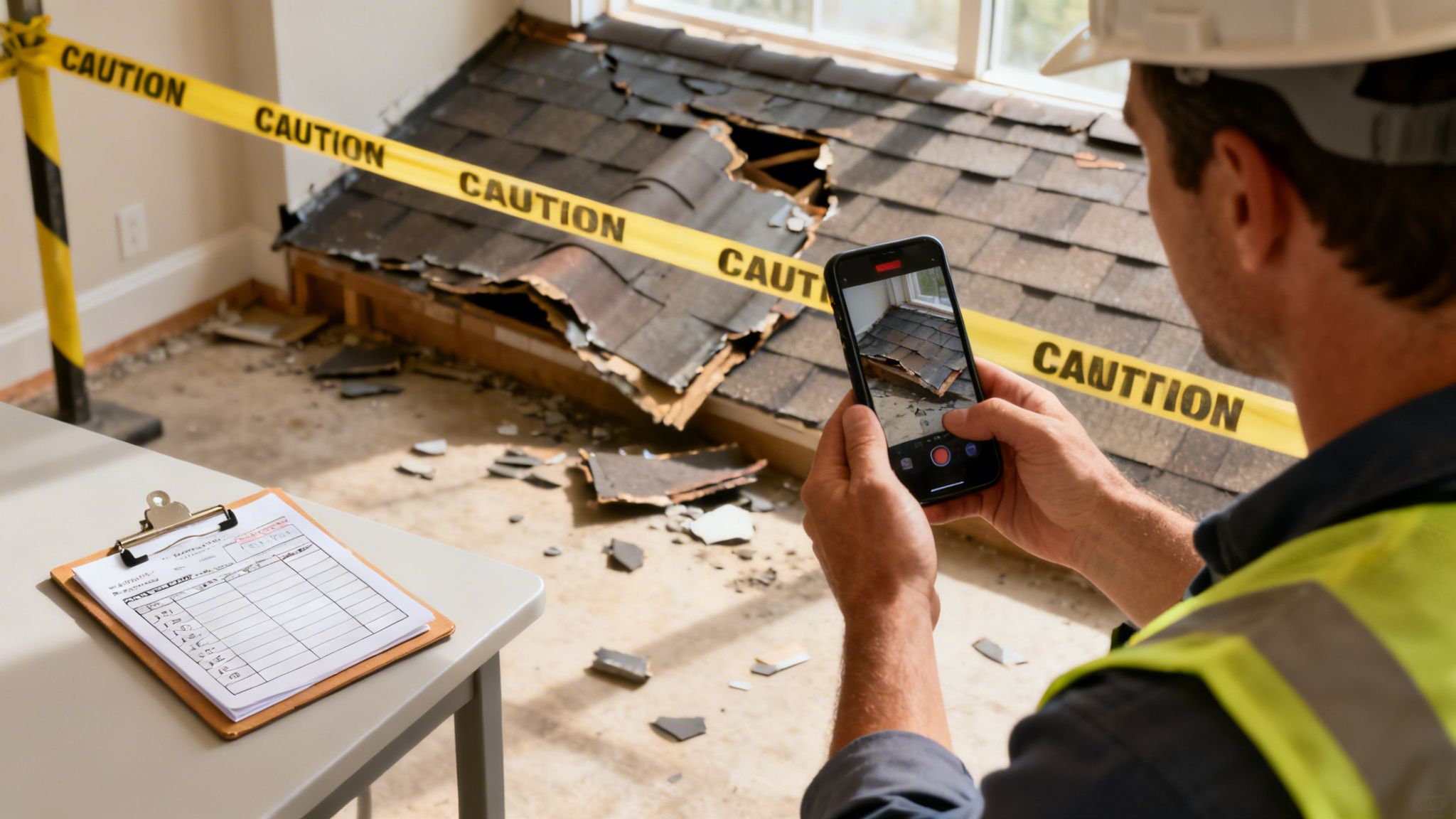
Despite careful planning, incidents can occur on a job site. When they do, maintaining a calm and methodical approach is the most effective way to manage the situation. While filing a builder's risk insurance claim may seem daunting, it is a logical process designed to get the project funded and back on track.
Immediately upon discovering damage, the first priority is to secure the site. Mitigate the problem by boarding up exposed openings, shutting off water mains, or cordoning off unstable areas. Preventing further damage is a policyholder's responsibility and demonstrates professional management to the insurer.
Document Everything Immediately
Before any debris is moved, it is imperative to document the scene thoroughly. This is a non-negotiable step. The evidence gathered in the initial moments forms the foundation of the entire claim.
Use a smartphone to take extensive photos and videos from every angle. Capture wide shots to show the context of the damage, then move in for close-ups of specific problems. The goal is to create a complete visual narrative for the claims adjuster who will approve the repair costs.
While documenting, begin a simple log. Note the date and time, what was found, and the actions taken to secure the site. This initial record will be invaluable later.
The most successful claims are built on a foundation of irrefutable proof. Your smartphone is your most powerful tool in the first few hours after a loss.
The Formal Claims Process
With the initial evidence gathered, it is time to initiate the official claims process. Do not delay. Most policies have strict deadlines for reporting a loss, and tardiness can jeopardize the claim.
Follow this straightforward plan:
- Call Your Agent Immediately: Your first call should be to your insurance agent. They understand your policy and can provide exact instructions on what the carrier requires to begin the process.
- Gather Your Paperwork: Consolidate all project documents, including police reports for theft, material receipts, subcontractor agreements, and project plans.
- Meet the Adjuster On-Site: The insurance company will dispatch a claims adjuster to assess the damage. Be present for this meeting. Walk them through the site, present your photos, and provide a clear account of what happened.
- Obtain Solid Repair Estimates: You will need to get detailed repair quotes from qualified contractors. Ensure these bids clearly itemize costs for labor and materials.
- Keep a Communication Log: Every time you communicate with the insurance company, document it. Note the date, the person you spoke with, and a summary of the discussion.
Once the claim is approved, the repair and payment phase begins. Understanding how insurance companies pay contractors is crucial for a smooth final step. Following this structured process transforms a chaotic event into a manageable project, helping you secure the funds needed to rebuild.
Your Top Builder's Risk Insurance Questions Answered
Even after grasping the fundamentals of builder's risk insurance, questions often arise once a project is underway. Here are straightforward answers to the most common inquiries from contractors and property owners.
What Happens When Construction Is Finished?
A builder's risk policy is a temporary shield, specifically designed for the vulnerabilities of the construction phase. Once the job is complete, the policy has served its purpose.
Coverage typically ends on the earliest of these dates: the policy's expiration date, the day the building is occupied or put to its intended use, or the date a certificate of occupancy is issued. It is critical to have a permanent property policy—such as homeowner's or commercial property insurance—in place before this occurs to avoid a dangerous gap in coverage.
Does This Insurance Cover Job Site Injuries?
No. This is a crucial distinction. Builder's risk is a form of property insurance. Its sole function is to protect the physical building and on-site materials from damage or loss.
If a visitor is injured on the job site, that falls under a Commercial General Liability (CGL) policy. If an employee is injured, that is a matter for Workers' Compensation. A truly protected project requires all three policies working in concert.
Can I Get Coverage for a Major Remodel?
Yes, and it is highly recommended. A standard homeowner's or commercial property policy often contains clauses that can limit or even void coverage during a major renovation. This can leave both the original structure and all new work dangerously exposed.
A builder's risk policy tailored for renovations is designed for this exact scenario. It covers the value of the existing structure and the new work, materials, and equipment. For any large-scale remodel, it is the only way to be fully protected.
What Is a Reporting Form Policy?
For busy contractors managing multiple projects annually, securing a new "one-shot" policy for each job is inefficient. A "reporting form" policy, also known as a master policy, is the solution.
A reporting form policy functions like a master account for all your jobs. Instead of starting from scratch each time, you simply report new projects as they begin, and they are covered under the existing policy terms.
This approach is not only more efficient but is often more cost-effective and saves significant administrative time. It helps maintain consistent coverage terms across all builds, providing a simpler way to manage insurance as your business scales.
Navigating the details of builder's risk insurance is simpler with an expert partner. Here at ISU Insurance Services, we specialize in helping California contractors and property owners secure the right protection. Contact us today, and we will help you compare your options and secure a policy that protects your investment from the ground up.